


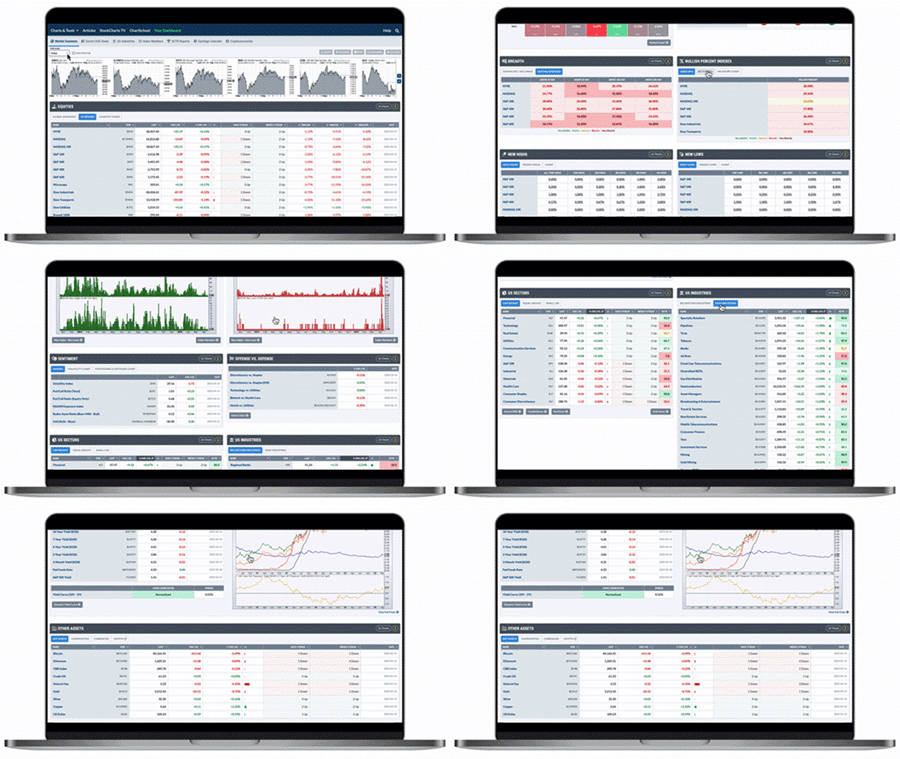

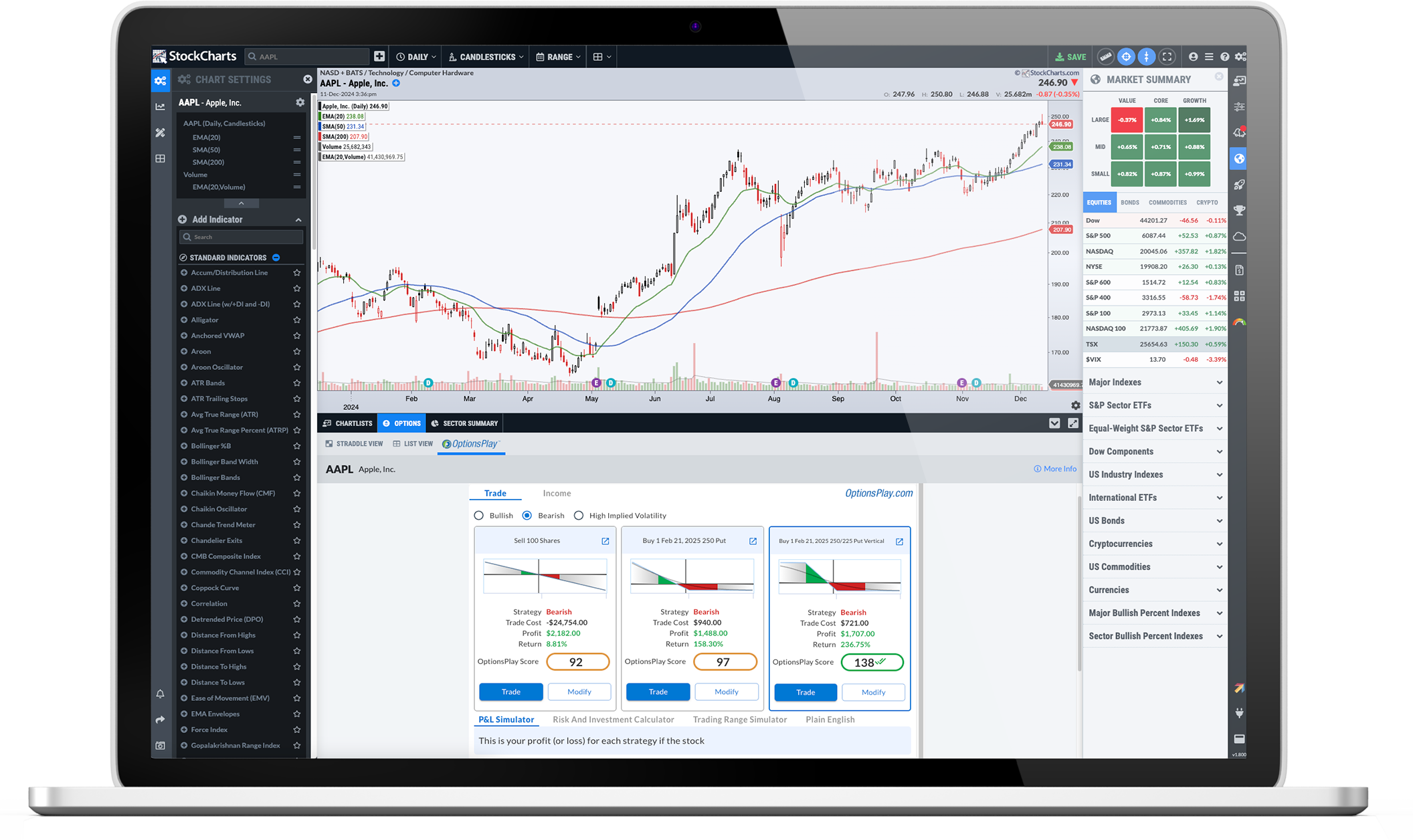
Everything you see on StockCharts is designed with one goal in mind: to help you succeed in the markets.
Our charting and analysis tools, portfolio management resources, and comprehensive data coverage deliver a complete package that can be uniquely tailored to fit any approach. That's why millions of investors around the globe have made StockCharts their trusted financial analysis platform for more than two decades.
From simple candlesticks to advanced technical visualizations, our award-winning charting tools help you see the markets clearly. Compare symbols over multiple timeframes, choose from dozens of powerful indicators, and customize your charts to suit your personal trading or investing style.
Whether you're looking for stocks making new highs or searching for complex setups that combine multiple technical indicators, our advanced market scanning tools give you the power find promising new trade targets or investment opportunities faster than ever before.
Stay ahead of the markets and on top of your portfolio with custom, automatic alerts for all of the symbols you're following. From simple price alerts to advanced combinations of specific technical and fundamental criteria, our custom alert features will help make sure you never miss a thing.
And that's just the tip of the iceberg. Our rich feature set provides comprehensive coverage for every step of your investing journey, from trading tools like Scheduled Scans to portfolio management resources like ChartList Reports.
Explore More Features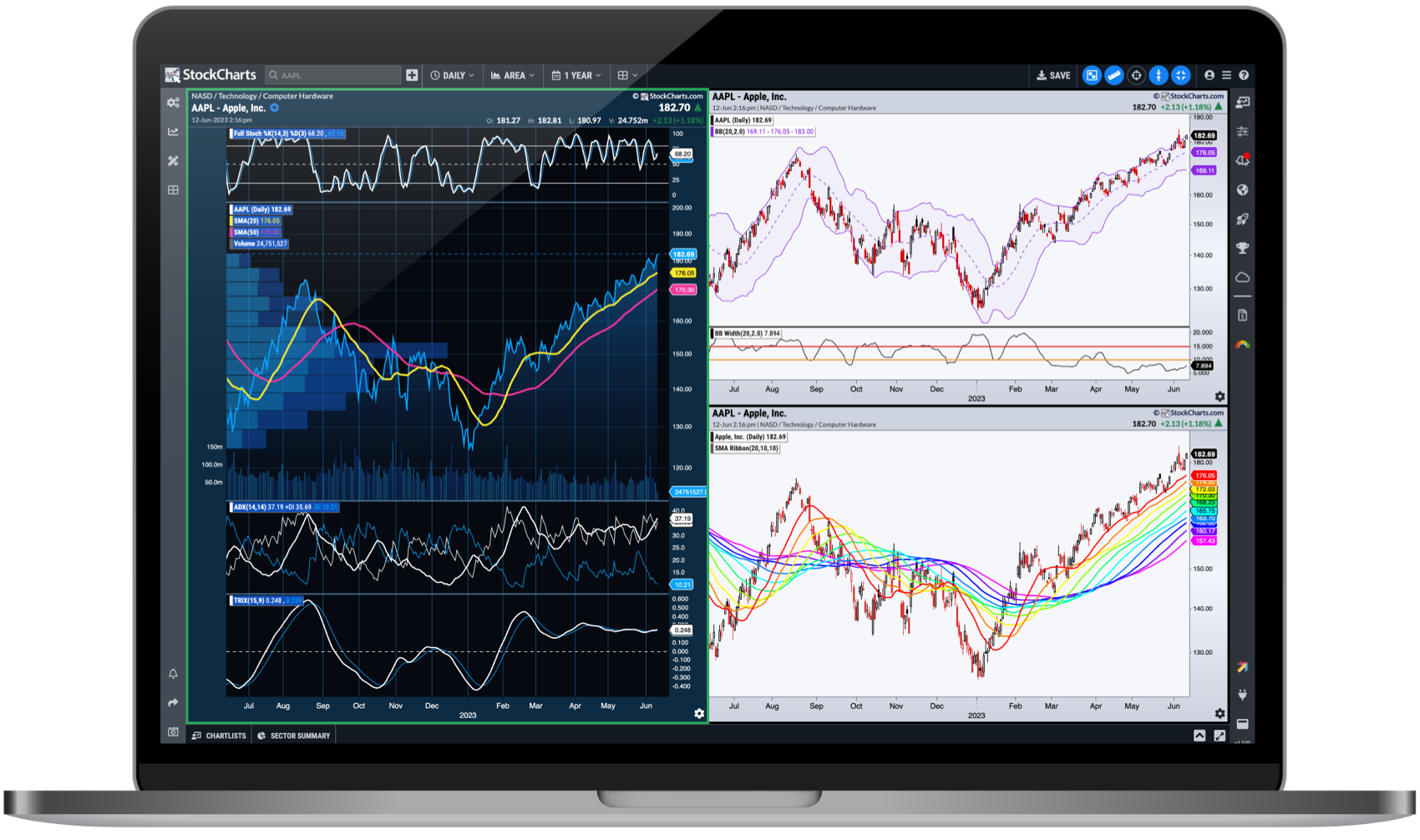
ACP is designed to redefine the way that you chart and analyze the financial markets, with more technical tools and capabilities than ever before.
Engage with the markets and your portfolio in entirely new ways with a highly-interactive charting experience that knows no bounds.
Every investor has different needs and ACP is designed to support them all, with a wide array of technical indicators and overlays, customizable multi-chart layouts, additional data views, and much more.
ACP brings you the web's most advanced technical charting platform, seamlessly integrated with the rest of the StockCharts feature set to create an unrivaled analysis and portfolio management toolkit.
Implementing STANAG 5069 involves upgrading "legacy" radio systems to Software Defined Radios (SDRs). These modern systems can switch between different STANAG waveforms (such as STANAG 4538 for automated linking or STANAG 5069 for high-speed data) via software updates.
While modern satellites provide high-speed connectivity, HF radio remains the primary "Plan B" for navies. It is cost-effective, does not rely on third-party satellite providers, and can transmit over the horizon by bouncing signals off the ionosphere. STANAG 5069 ensures that when a French frigate sends an HF data burst, a British destroyer or a U.S. Navy shore station can interpret it perfectly. Key Technical Objectives The core of STANAG 5069 is built around three main pillars: 1. Robust Data Links
Navies are returning to HF as a resilient, sovereign alternative. STANAG 5069 allows NATO allies to maintain a even when satellite links are severed. It provides a "denied-environment" lifeline that ensures command and control (C2) remains functional. Implementation and the Future
The "I" in NATO stands for international, but in the field, it stands for Interoperability. STANAG 5069 provides a common language for modem manufacturers. Whether a navy uses hardware from Rohde & Schwarz, Harris, or Thales, as long as the equipment is compliant with STANAG 5069, the platforms can "talk" to one another. Why is STANAG 5069 Critical Today?
As a NATO Standardization Agreement (STANAG), 5069 serves as a critical technical blueprint for maritime digital communications. Below, we explore what this standard entails, why it matters, and how it shapes modern naval warfare. What is STANAG 5069?
Upgrade your toolkit with our premium features now in less than 60 seconds.
Implementing STANAG 5069 involves upgrading "legacy" radio systems to Software Defined Radios (SDRs). These modern systems can switch between different STANAG waveforms (such as STANAG 4538 for automated linking or STANAG 5069 for high-speed data) via software updates.
While modern satellites provide high-speed connectivity, HF radio remains the primary "Plan B" for navies. It is cost-effective, does not rely on third-party satellite providers, and can transmit over the horizon by bouncing signals off the ionosphere. STANAG 5069 ensures that when a French frigate sends an HF data burst, a British destroyer or a U.S. Navy shore station can interpret it perfectly. Key Technical Objectives The core of STANAG 5069 is built around three main pillars: 1. Robust Data Links
Navies are returning to HF as a resilient, sovereign alternative. STANAG 5069 allows NATO allies to maintain a even when satellite links are severed. It provides a "denied-environment" lifeline that ensures command and control (C2) remains functional. Implementation and the Future
The "I" in NATO stands for international, but in the field, it stands for Interoperability. STANAG 5069 provides a common language for modem manufacturers. Whether a navy uses hardware from Rohde & Schwarz, Harris, or Thales, as long as the equipment is compliant with STANAG 5069, the platforms can "talk" to one another. Why is STANAG 5069 Critical Today?
As a NATO Standardization Agreement (STANAG), 5069 serves as a critical technical blueprint for maritime digital communications. Below, we explore what this standard entails, why it matters, and how it shapes modern naval warfare. What is STANAG 5069?
Visit our Support Center or contact our support team for answers and assistance.
Support Center